Activities
Why Musician G-Dragon Went to the Museum
2015.06.13
Min Kyung-won | JoongAng Daily Reporter
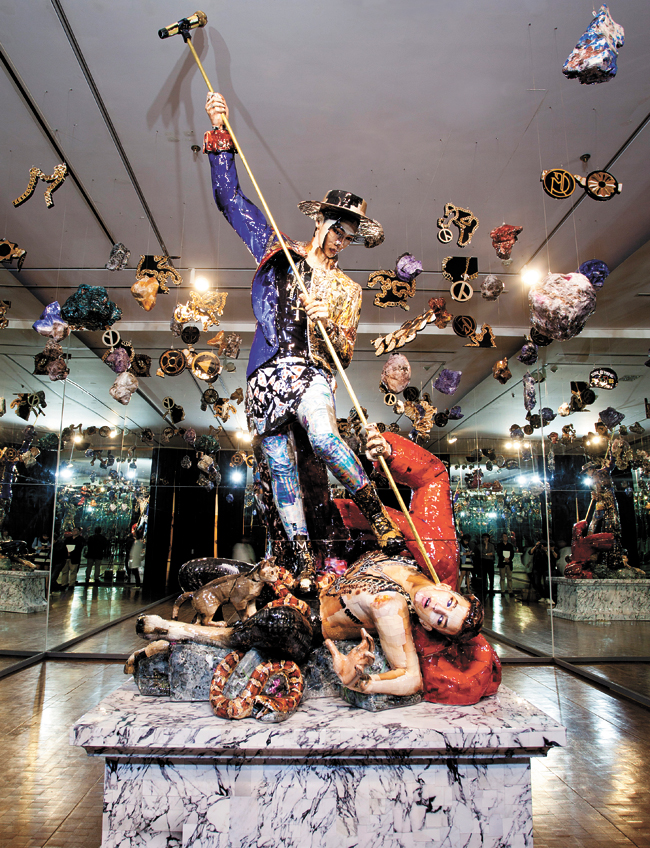
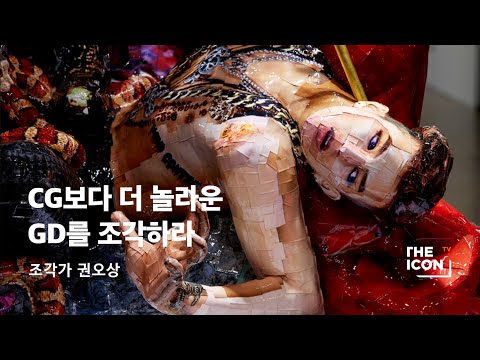
Gwon Osang, Untitled G-Dragon, A Space of No Name, 2015 © Gwon Osang
PEACEMINUSONE. This term encapsulates the
worldview pursued by G-Dragon (27, birth name Kwon Jiyong) of the group
BIGBANG. It suggests that between a peaceful, utopian world and a reality
marked by lack, there exists a point of intersection where ideals and reality
meet. The exhibition 《PEACEMINUSONE: Beyond the
Stage》 (June 9–August 23), held at the Seosomun Main
Branch of the Seoul Museum of Art, is based on this very philosophy of
G-Dragon.
As the first curated exhibition by a pop
music star to be held in a Korean museum, it has garnered significant
attention. After all, who is G-Dragon? A style icon who moves fluidly between
music and fashion—every song he releases dominates the music charts, and
everything he wears sells out instantly.
At a press conference on the 8th, G-Dragon
stated, “As a singer, I am constantly exposed to the public, so through
directing music videos and working on album jackets, I found myself naturally
learning—almost without realizing it.” He added, “I may be just a small medium,
but I hope that through me, many people will come to visit the museum and
experience it as an enjoyable space.” What kind of world has he created through
collaborations with fourteen teams of artists from Korea and abroad?
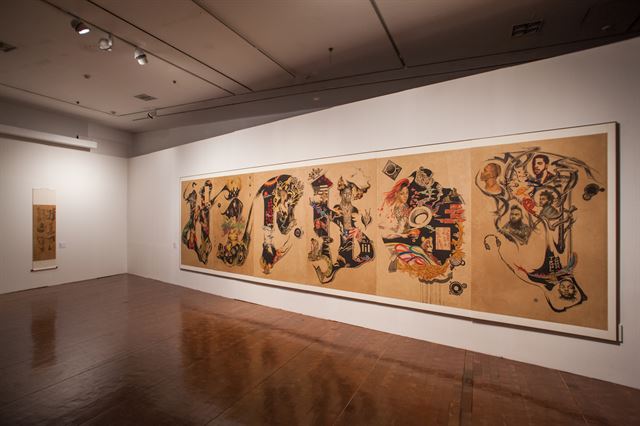
Son Donghyun, (Portrait of) the Hip Hop, 2015 © Son Donghyun
From Munjado to Angel Sculptures:
Experiencing G-Dragon’s Sensibility Through Sight
The introductory section, the (Non)fiction
Museum, feels almost like a glimpse into G-Dragon’s mind. The first thing that
catches the eye is a large circular clock stopped at eight o’clock. Made from
clothes he once wore and emphasizing the number 8—his personal lucky number—the
installation symbolically presents this space as one that exists entirely for
him.
Created in collaboration with the artist group Fabriker, the space
combines dim lighting with soft carpeting to evoke a dreamlike atmosphere. Even
the scent, designed to stimulate the viewer’s sense of smell, was personally
selected by G-Dragon—making it truly a case of “Welcome to GD World.”
The audio guide, recorded by G-Dragon
himself, shares stories about the collection and his relationships with the
artists. One notable example is Obic, an emerging artist based in New York. “I
first came across him through Instagram, and later had the chance to visit his
studio and build a relationship,” G-Dragon explained. “Wanting to support a
young artist, I ended up collaborating with him on my second solo album.”
He added, “Since I’m still in the process
of learning about art, I don’t have a specific standard for collecting.”
However, his taste begins to emerge through works such as Tracey Emin’s neon
installation I promise to love you, which he says resonated
deeply with him given his tendency to write about love in his lyrics, and Jason
Martin’s Fetish, a sensual swirling composition rendered in
a single color on aluminum rather than canvas.
His favorite work, he noted, is
a reinterpretation of Gerrit Rietveld’s Red-Blue Chair—recreated in
najeonchilgi (mother-of-pearl lacquerware) in collaboration with master
craftsman Bae Myungju. This suggests that beyond simply viewing, collecting,
and enjoying art, we may eventually encounter him as a designer who creates his
own works.
The exhibition expands the temporal and
spatial universe of PEACEMINUSONE while illuminating G-Dragon as an artist from
multiple perspectives. The architectural firm SoA has even transformed the
staircase connecting the second and third floors into part of the exhibition
space. By reconfiguring scaffolding typically used behind temporary stages and
moldings familiar to painters, the structure becomes a passage that connects
the virtual and the real.
The space for conveying messages and
images is not confined to the canvas. Artist Son Donghyun interprets
hip-hop—G-Dragon’s primary artistic domain—through the most traditional East
Asian format: munjado (文字圖). The six letters of
“HIPHOP” are transformed into a portrait that encompasses around twenty
figures, from 2PAC, a defining artist of the 1990s, to contemporary rapper
Kendrick Lamar, offering a panoramic view of hip-hop history at a glance.
A similar logic applies to the fragmented
fantasy of French artist Fabien Verschaere. Thirty words selected by G-Dragon
are organized into opposing pairs such as “life” and “death.” The work
resonates with Verschaere’s recurring motif of hybrid monsters—born from his
childhood experiences of frequent illness and hospitalization—and aligns
strikingly with G-Dragon’s ongoing contemplation of identity, caught between
his stage persona and his real self, Kwon Jiyong.
There are also works that fans will find
especially compelling. Artist Gwon Osang, known for transforming flat
photographs into sculptural photo-objects, has assembled images of G-Dragon
circulating online into a monumental sculpture depicting Saint Michael the
Archangel battling the devil.
Mirrors installed throughout the work endlessly
reflect one another, layering the duality of good and evil with the dichotomy
of subject and object, prompting viewers to reflect. “We developed the idea
over nearly a year of discussion, from planning to production,” Kwon said.
“G-Dragon has a particular interest in meteorites, so we even referenced the
same book and incorporated imagery from it,” he added, sharing his thoughts on
the collaboration.
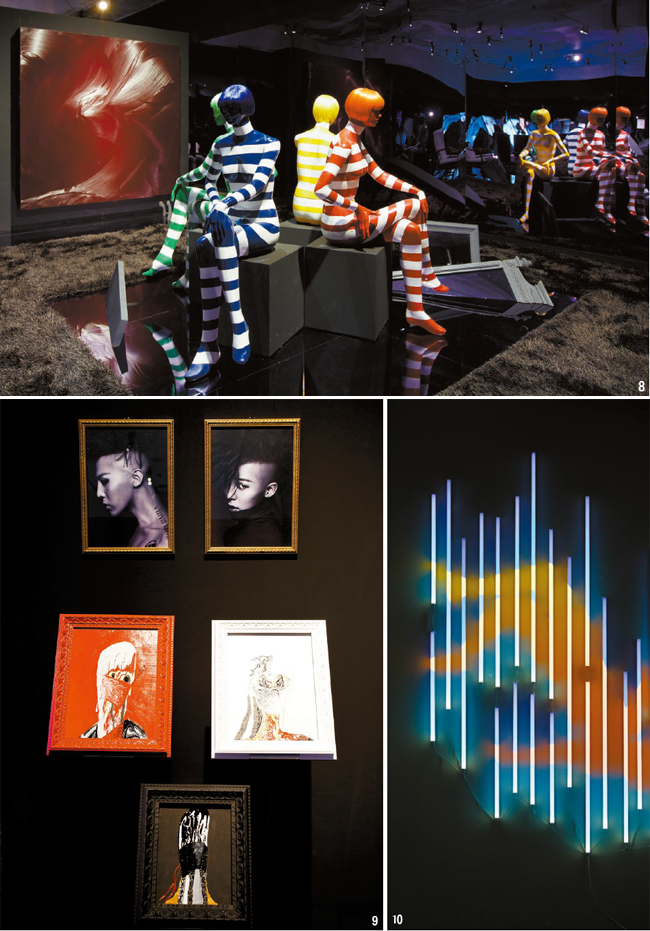
Installation view of 《PEACEMINUSONE: Beyond the Stage》 © SeMA
“If even one artist or one
artwork becomes known through me, I would be satisfied.”
However, not all aspects of the exhibition
unfold with consistency. Beyond the fact that the fourteen participating
artists each possess distinct practices, in some cases it is difficult to
identify a clear connection to G-Dragon. For instance, Captive
by London-based Italian artist Quayola is a sculpture carved by a robot in
Korea based on a digital design by the artist.
While it is meaningful as one of
the first attempts at digital fabrication in Korea, the explanation that its
point of connection lies in the shared global circulation of G-Dragon through
social media—and the diverse ways in which he is aesthetically consumed—feels
somewhat strained.
Similarly, the work of American artist
Michael Scoggins, the only participating artist who did not know who G-Dragon
was, appears to connect to him solely through the lyric “I can’t breathe.” Even
this phrase originates from the last words of Eric Garner, who died due to
excessive police force in the United States last year, raising further
questions about how such a connection should be interpreted. The mixture of
pre-existing works and newly commissioned pieces also contributes to a sense of
disjunction.
Kim Hong-hee, director of the Seoul Museum
of Art, who curated the exhibition at the suggestion of YG Entertainment,
remarked, “Post-museum curation regards exhibitions as interpretive texts,
prioritizes contemporaneity over the asset value of artworks, and advocates
cross-genre practices,” adding that “this exhibition will serve as a compelling
example demonstrating the convergence of high art and popular culture.”
However, the comparison to global figures such as British musician David Bowie
or Icelandic artist Björk—whom Kim cited as precedents—inevitably differs in
texture, as their practices are built upon decades of accumulated artistic
legacy.
That said, G-Dragon’s own defense carries
a certain validity. Just as he composed his new track “BAE BAE” inspired by the
work of Francis Bacon, yet cannot precisely pinpoint which part of the song
reflects that influence, art by nature tends to permeate rather than overtly
declare itself. His aspiration is, in fact, quite modest: “For those who have
never studied art beyond school classes, if they come to the museum because of
me, and even casually come to know the name of one artist or one artwork, wouldn’t
that itself be a form of learning?”
Much like the line from his solo track
“Coup d’Etat”—“The revolution will not be televised. The revolution is in your
mind. The revolution is here”—his effort toward change deserves to be fully
supported. After all, some kind of stepping stone is necessary before one can
cross the high threshold of contemporary art and encounter works that truly
move the heart. Everyone has a beginning.
References
Activities