Activities
[Interview] Interview with Aesthetica Magazine
2009
Aesthetica Magazine
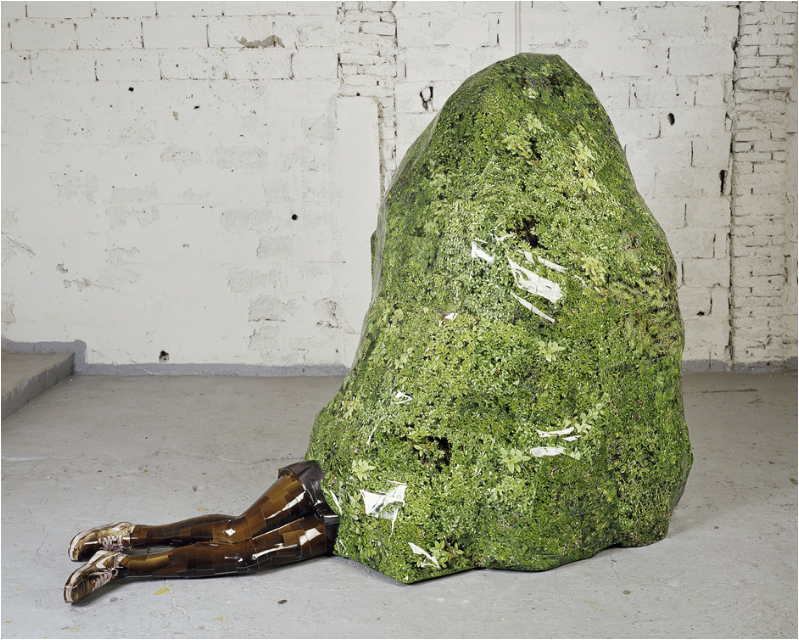
〈Limbo Garden〉, 2007, C-print, Mixed media, 177 x 120 x 245 (h) cm ©Artist
Some of your works, specifically in the ‘Deodorant Type’ series, feature figures with deformities or additional limbs or appendages. Is this reflective of an interest in the “abnormal” physical nature of the human body?
In the beginning of the ‘Deodorant Type’ series between the late 1990s and the early 2000s, a large number of such works were made. In regard to the mixing of sculpture and photography I focused on the mechanism of photography involving magnification, reduction, duplication and manipulation in photography. This was also one of the artistic characteristics of the era at the time. Besides I think constructing plaster casts to remake the original form is similar to the process of developing negatives and printing in photography.
You have been called the Duane Hanson of Korean art; how do you see your work in relation to his work?
Oh~, this is my first time to hear such comment. Do people in your circle of friends or acquaintances call me that? That could be because the human figures that I make wear cloths. I never really thought about it thoroughly. Aren’t they very different from mine?
A lot of critics would argue that as a Korean artist who lives and works in Korea, you produce art which is inherently different to that produced by an artist born in Korea but living and working elsewhere (e.g. Rikrit Tiravanija). Do you think that as an artist living and working in Seoul your work is necessarily influenced by different factors / conditions?
I can say that compared to other Asian artists who live and work in Western countries, I don’t have a complex.
In this current situation I won’t be influenced by that. Because I am Asian and the work comes from its home country. While many Asian artists make artworks generally based on identity and political issues, artists working in Korea seem to make artworks that are not associated with ethnic backgrounds or countries but rather focus on fundamental issues that we experience living as a human.
Your work tends to look at the idea of appearance – that it is a facade and all we truly are are fragmented parts making a whole. Your ‘Deoderant Type’ series seems to take this literally by photographing parts of the subject’s body and then reassembling the prints to reconstitute the whole. How did you initially become interested in this idea of fragmentation of appearance?
I don’t know about other artists, but I believe that art making is a collective outcome of well trained sense and intuition of the artist and not something comes out of a logical result. About the fragmentation in my work, I think it is due to the issue involving the way that a 2-D object becomes a 3-D object and the size of photograph that is not special.
Your work negotiates the identity of your own subjects. Do you see yourself as forming the subject’s appearance into the way you view them?
Rather I think my work is far from the identity of the subject. Not into the way I view them but rather the subject’s appearance is formed into the way the camera views them. I think it is no different from the camera casting the surface of the subject.
Your work is neither strictly sculpture or photography, but a fusion of the two. Lately, with your ‘Sculpture’ series, you seem to be concentrating more on the practice of sculpture – was this a conscious decision?
That’s right. Actually I felt that it is more difficult and attractive to tell stories about something in a classical and academic way than a fusion. Also I believe that there is a reason why the classical genre lasted for thousands of years.
With the ‘Deoderant Type’ series you take the superficial appearance of the human body and fragment it to expose it’s flaws; with the ‘Flat’ series you take luxury goods and commodities (by cutting the images out of magazines) and place them outside the context in which they make sense (the magazine itself) thereby highlighting their insignificance in the real world; with the ‘Sculpture’ series you take real, tangible objects and make them look almost ‘unreal’ (e.g. with Sculpture 2 where the car looks like the skin of an orange, making you want to bite it). There is always an underlying subersive element to your work in this way. Where does this desire to upend or subvert preconceived images and ideas come from?
May be because of my laziness? I don’t feel the need to work with images that are special and precious when taking my role as an artist. Those images can be easily found around me or in any civilized city life on earth through magazines or internet; they are very close to me and easily attainable.
What do you want UK audiences to take away from your work?
Now city life is the same wherever you go in the world. I don’t really want UK audiences to understand something special by looking at my work. This is my concept of contemporary art, rather I expect them to have a variety of misunderstandings. I think misunderstanding is a way of communication.
Activities